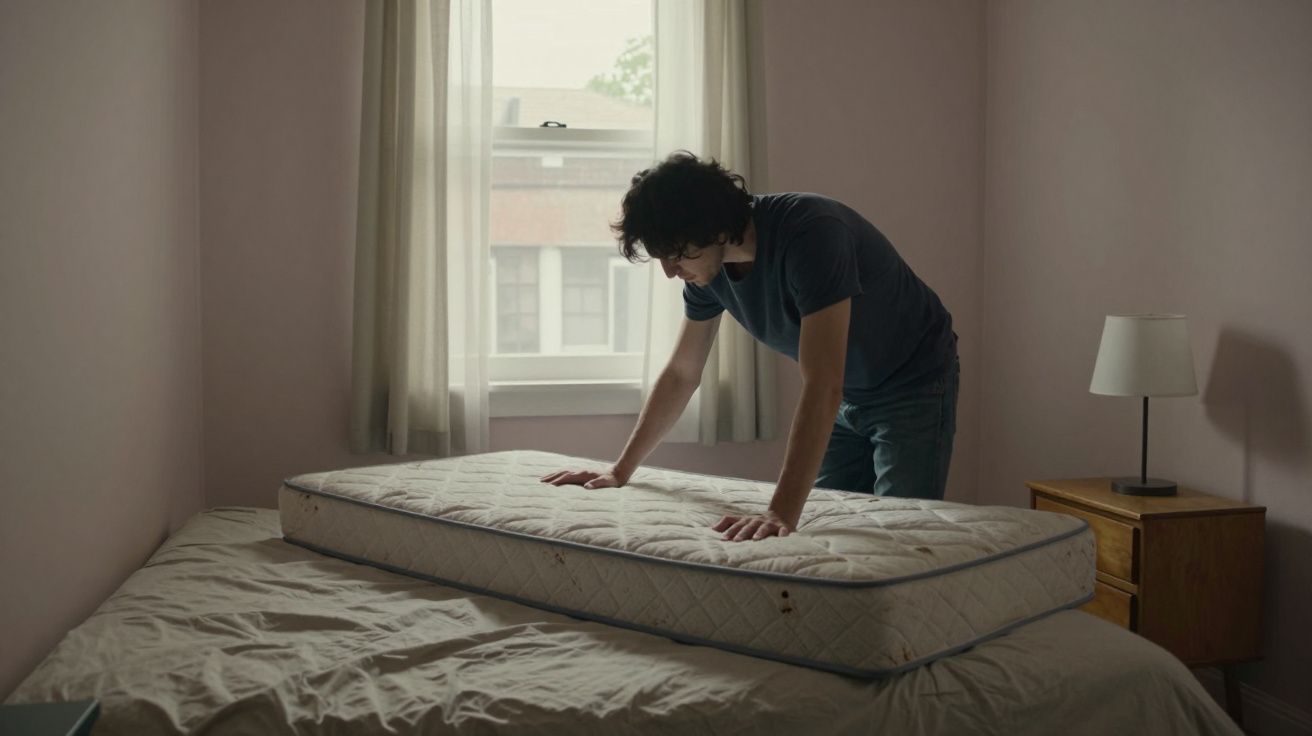
You wake up with a shoulder that feels like it slept on a sack of potatoes. You roll to the middle of the bed and automatically fall into that familiar dip, the groove your body has carved over the years. The sheet smells vaguely of last summer’s heatwave and last week’s late-night snacks. You tell yourself you “just slept funny”.
At some point, half asleep, you pat the mattress and think, “We only bought this a few years ago.” Except, if you actually did the maths, “a few years” might quietly add up to eight… or twelve.
Mattresses age in slow motion. They don’t suddenly collapse like a broken chair; they fade. A centimetre of sag here, a squeak there, a faint mustiness you only notice when you change the bed. It’s easy to convince yourself it’s fine, because replacing it sounds expensive and annoying. Yet sleep specialists will tell you: most of us are clinging to mattresses long past their bedtime.
There’s a surprisingly simple home test they use to decide when it’s time to stop pretending and start planning. They literally flip the mattress… and sniff it.
The quietly ageing mattress under your nose
If you ask people how old their mattress is, few can answer confidently. They’ll frown, count back through rented flats, new jobs, partners, the baby that is now in secondary school. Somewhere in that fog, the truth emerges: this thing has been with you longer than some friendships.
In studies of bedroom hygiene, researchers repeatedly find the same pattern. Most adults keep mattresses 10–15 years. Industry guidance is closer to 7–10, sometimes less depending on type and usage. The gap between those numbers is years of sleeping on something your back has technically outgrown.
Inside the fabric, your mattress is quietly changing shape and chemistry. Foam compresses and doesn’t spring back. Springs lose tension. The filling shifts and clumps. You shed skin cells into it every night, sweat into it on hot evenings, and, over time, dust mites move in to enjoy the buffet. None of this is dramatic. It’s just gradual, background decay.
On the surface, your bed may still look OK with a tight sheet and a nice throw. Underneath, it might be harbouring a cocktail of flattened support, trapped moisture and stale odours that your brain has simply got used to.
That’s where the “flip and sniff” rule comes in.
The “flip and sniff” rule sleep specialists swear by
Sleep professionals don’t just poke a mattress and guess. They run simple, practical checks that anyone can copy at home in ten minutes. One of the most revealing is exactly what it sounds like: flip the mattress, then sniff it.
Think of it as an MOT for your bed, not a weird new wellness ritual.
Here’s how to do it without turning your bedroom into a crime scene:
Strip everything off
Remove duvet, sheets, protectors, toppers – the lot. You want bare mattress fabric.Check the age tag
Most mattresses have a small label with a manufacturing date. If it’s over 8 years old (or over 6 for cheaper foam and open-coil types), that alone is a yellow flag.Flip or rotate it
- If your mattress is double‑sided, turn it over.
- If it’s single‑sided, rotate head-to-foot.
This exposes parts that haven’t been pressed against slats or divan for years.
- If your mattress is double‑sided, turn it over.
Look for the “fault lines”
With fresh eyes, scan for:- Visible dips or valleys where you usually lie
- Lumps, ridges or hard lines over springs or slats
- Frayed seams, torn fabric or exposed filling
Press down with a flat hand. A healthy mattress should feel broadly even, not like a series of hills and potholes.
- Visible dips or valleys where you usually lie
Now, the sniff test
Get close (yes, really) and take a deliberate sniff along different areas:- A mild, neutral, slightly “textile” smell is normal.
- A musty, damp or old-sweat odour is a red flag.
- A sharp, stale smell that springs back when the room is closed for a day suggests trapped moisture and heavy use.
- A mild, neutral, slightly “textile” smell is normal.
Notice how your body feels on it
Lie down for 3–5 minutes in your usual sleep position. Pay attention to:- Pressure points (hips, shoulders, lower back)
- Whether your spine feels roughly straight or bowed
- Any pins and needles or instant fidgeting
Your body is often more honest than your brain.
- Pressure points (hips, shoulders, lower back)
If the mattress looks uneven, smells off, and leaves you feeling unsupported, most sleep experts would say you’re past the stage of “making do”. You’re in replacement territory.
The subtle signs your mattress is past its bedtime
Mattresses rarely fail with a bang. They whisper their complaints in little ways that are easy to shrug off as age, stress, or “sleeping funny”. When you line those whispers up, a clearer story appears.
Common red flags:
You wake up sorer than you went to bed
Morning stiffness in your lower back, neck or hips that eases as you move around can be a sign your mattress isn’t supporting your natural curves.There’s a visible dip where you sleep
If you can lay a broom handle across the bed and see daylight under the middle, or you automatically roll into a trench, the internal structure is giving up.You sleep better anywhere else
You mysteriously wake refreshed after a night in a hotel or on a friend’s spare bed, but feel wrecked at home. The common denominator isn’t you; it’s your mattress.Your allergies flare in bed
More sneezing, itchy eyes or a stuffy nose at night can point to dust mites and allergens building up in an older mattress, especially if the room is fairly clean.It’s suddenly noisy
Springs squeak when you turn over, or your partner’s slightest move judders the whole bed. That often means metal components or fillings have shifted out of place.
One of these alone isn’t always a deal-breaker. Several together, plus a “failed” flip-and-sniff, usually are.
How long should a mattress actually last?
Not all mattresses age at the same speed. Quality, body weight, whether you share with a partner (or children, or pets), and how well you protect it all make a difference. But rough guidelines do help.
Here’s how sleep specialists often summarise it:
| Mattress type | Typical lifespan* | Common weak spot |
|---|---|---|
| Basic foam / open coil | 5–7 years | Sagging, loss of support |
| Pocket sprung / hybrid | 7–10 years | Dips in heavy-use areas |
| High‑quality latex | 10–12+ years | Gradual firmness change |
*Assuming regular use by one or two adults and basic care.
If your mattress is near the upper end of its range and showing any of the warning signs, it’s sensible to start budgeting for a replacement rather than squeezing out “just one more year” indefinitely.
Let’s be honest: people often keep mattresses until they’re embarrassing to move house with. The goal isn’t perfection; it’s avoiding the long, slow slide into sleeping on something your body has quietly outgrown.
What if replacing it isn’t in the budget yet?
A new mattress can be a big outlay, especially in a cost‑of‑living squeeze. If your flip-and-sniff suggests it’s time to part ways but your bank account disagrees, there are ways to buy time while you save.
Think of these as damage‑limitation steps, not magic fixes:
Rotate regularly
Turn the mattress head‑to‑foot every 3–6 months to spread wear, especially if one of you is heavier or always sleeps on the same side.Add a supportive topper
A decent, medium‑firm topper can soften lumps and improve comfort on a too‑hard or slightly uneven surface. It won’t fix a deep sag, but it can make nights more bearable.Check the bed base
Slats that are bowed, broken or spaced too far apart can exaggerate dips. Sometimes a simple slat repair or adding a solid board underneath buys you some support back.Deep clean and air it
Vacuum the surface slowly with an upholstery tool, spot‑clean stains, then let the mattress air with windows open for several hours. A clean, dry mattress smells better and tends to harbour fewer allergens.Use a proper protector
A washable, breathable mattress protector shields from sweat, spills and skin cells. It won’t reverse age, but it slows further damage while you plan your replacement.
None of these turn a 12‑year‑old, sagging mattress into a brand‑new one. They simply help you sleep as comfortably and hygienically as possible in the meantime.
Rethinking “putting up with” a tired bed
Many of us will change phones, shoes and streaming services far more often than we change the thing we spend a third of our life lying on. We treat decent sleep like a luxury, then wonder why our back aches and coffee feels like a basic survival tool.
The “flip and sniff” rule isn’t about shaming you for having an old mattress. It’s about making the invisible visible. When you actually look at the date, see the dips, and catch that faint mustiness you’d stopped noticing, decisions get clearer. Not overnight, not perfectly, but steadily.
A better mattress won’t solve every problem in your life. What it does offer is quieter nights, fewer 3 a.m. fidgets, and mornings where you stand up without swearing at your spine. That’s not indulgence; it’s basic infrastructure for the rest of your day.
The next time you strip the bed, pause before you rush to new sheets. Flip it. Sniff it. Listen to what your body says when you lie down on the bare surface for a few minutes. If the message is “I’m done”, you don’t have to replace it tomorrow – but you’ll know it’s time to start planning for a different kind of night’s sleep.
FAQ:
- Do I really need to replace my mattress every 8 years?
Not automatically, but 7–10 years is a useful guideline for many mattresses. If yours is older and showing signs of sagging, odour, poor support or increased aches, it’s sensible to plan a replacement.- Is a musty smell always a sign of something serious?
A mild “old fabric” scent isn’t unusual, especially in older homes. A stronger, persistent musty or damp odour, particularly after airing, suggests trapped moisture, sweat and possibly mould or heavy dust‑mite build‑up.- Can I fix a sagging mattress with a topper alone?
A topper can improve comfort on a slightly uneven or too‑firm mattress, but it can’t repair broken springs or a deep valley. If you can see or feel a pronounced dip, a topper is a short‑term comfort patch, not a long‑term solution.- Are second‑hand mattresses ever a good idea?
They’re generally risky from a hygiene and support point of view. You can’t see dust mites, bodily fluids or internal damage. If you must use one temporarily, always use a high‑quality protector and carry out the same flip‑and‑sniff checks.- How can I make a new mattress last longer?
Use a breathable protector from day one, rotate it as recommended, keep the bedroom well‑ventilated, vacuum the surface a few times a year, and avoid sitting on the same edge in the same spot every day. Little habits add up to extra years of comfortable use.





Comments (0)
No comments yet. Be the first to comment!
Leave a Comment