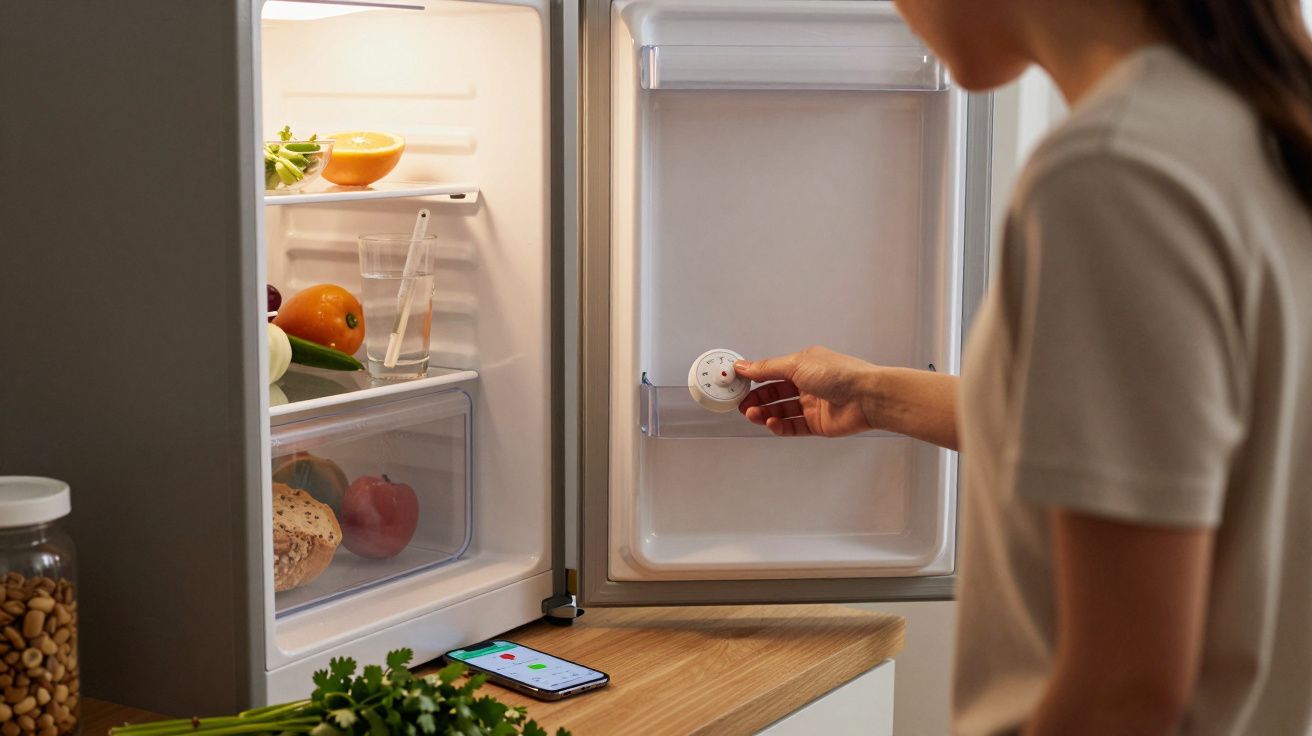
The chilli con carne was ready, the rice was on, and you opened the fridge for the coriander. The milk had ice crystals, the cucumber was half-frozen, and the butter was a brick. At the same time, your energy app kept nudging: “You used more electricity than last week.” You turned the dial down months ago “to be safe” and never thought about it again. That cheap safety net is probably costing you.
In most UK kitchens, fridges are running colder than they need to, especially in winter when the room itself is cooler. The twist: a £3 thermometer and one quiet evening can protect your food and shave a slice off your winter electricity bill. No gadgets, no smart plugs. Just one number on a dial that finally means something.
Why a degree or two matters
Your fridge has two jobs: keep food cold enough to slow bacteria, but not so cold that it wastes power or ruins texture. In UK guidance, the safe zone is between 0°C and 5°C. In practice, most foods are happiest around 3–4°C.
Above about 8°C, bacteria party. Raw meat, leftovers and open dairy move towards the “danger zone” where food poisoning risks climb. Below 0°C, you are not making your food safer; you are just turning salad into slush and forcing the compressor to work harder.
Rough rule: every unnecessary degree colder can add several per cent to your fridge’s energy use over a year.
In winter, many kitchens drop a few degrees. Your fridge doesn’t automatically adjust itself to that new baseline. The setting that was “about right” in July can be overkill in January. You spend more on electricity to make already-cool air even colder than it needs to be.
The 30‑second thermometer check
You do not need an engineering degree to set a fridge properly. You need a simple fridge thermometer and one overnight check.
- Get the right tool. A basic fridge/freezer thermometer from a supermarket or hardware shop is fine. If you have an instant‑read kitchen thermometer, that can work too.
- Measure the food temperature, not just the air. Put the thermometer probe into a glass of water and place it on the middle shelf, away from the door and the back wall.
- Close the door and leave it. Check the reading after at least eight hours, ideally overnight when you are not opening the door.
- Aim for 3–5°C. If it is lower than 2°C, turn the dial up (towards “warmer”) by one notch. If it is above 5°C, turn it down slightly (towards “colder”).
Do the same for your freezer if the thermometer is rated for low temperatures. You are aiming for about −18°C. Lower than −20°C is rarely useful at home; higher than −15°C could shorten storage times.
What your fridge dial is really doing
Most fridge dials are vague: 1–5, snowflakes, or “min–max”. They do not map neatly to degrees. That is why guessing leaves you with frozen lettuce and a humming motor.
Think of the dial as “how hard the fridge tries”, not a target temperature. Turning it all the way up makes the compressor run more aggressively, especially when the room is already cool.
Use your thermometer reading as the anchor:
- If you are below 2°C, nudge the dial one step warmer.
- If you are above 5°C, nudge the dial one step colder.
- After each change, wait 12–24 hours and re‑check with the thermometer-in-water trick.
A couple of small adjustments usually land you in the sweet spot. Once you find the dial position that gives roughly 3–4°C in winter, make a tiny mark with tape or a pen so you can return to it easily.
How cold is “too cold”?
A quick guide to what those numbers mean in real life:
| Fridge temp | What happens to food | What happens to your bill |
|---|---|---|
| 6–8°C | Safe for many foods, but shorter life for meat, milk, leftovers | Energy OK, food waste risk rises |
| 3–5°C | Ideal safety and shelf life for most items | Best balance of safety and efficiency |
| 0–2°C | Some foods start to freeze; textures suffer | Colder than needed, energy use creeps up |
You will not notice the bill change in a single week. Over a year, especially with rising tariffs, “always on” appliances like fridges are exactly where small tweaks add up.
Winter quirks most people miss
Cold weather does not mean your fridge can never be too cold. It just changes how and where the problems show up.
- Cool kitchens + low dial = semi‑frozen fridge. In a draughty or unheated kitchen, an aggressive setting that made sense in a heatwave turns milk to slush in January.
- Garages and outbuildings are awkward. If the ambient temperature drops close to or below 0°C, a fridge‑freezer in the garage may cool the fridge section too much while the freezer section warms, because the thermostat only reads one compartment.
- Overloaded festive fridges have hot and cold zones. Packed shelves, foil trays and bottles block air flow. The back can sit near freezing while the door shelves drift warm.
Treat your fridge like a room with micro‑climates. Middle shelves are your reference point; doors and corners are the wild west.
Once you know where the stable spots are, you can store smarter: raw meat and milk in the coldest section, herbs and salad in a slightly warmer drawer, sauces and pickles in the door where small fluctuations matter less.
Small habits that quietly cut costs
After the thermometer check, a few simple routines protect both food and energy.
- Let hot food steam off first. Cool leftovers on the counter for 20–30 minutes (no more than 90) before chilling. Putting a hot pan straight in makes the motor work overtime.
- Don’t store more cold air than you need. A reasonably full fridge is more stable than an almost empty one, but you do not need it crammed. Jugs of water or a couple of bottles can help buffer temperature if your fridge is bare.
- Check door seals. Close a thin piece of paper in the door and gently tug. If it slides out easily all round, the seal may be failing and you are chilling the whole kitchen.
- Defrost thick ice in freezers. More than about 5 mm of ice on the walls acts like a jumper for the coils and forces them to work harder.
- Keep a gap around the back. A few centimetres clearance helps warm air escape and stops the compressor running longer than it should.
None of these changes your life in a theatrical way. Together with a right‑sized temperature, they smooth the fridge’s workload and stretch the life of food you have already paid for.
A simple weekend fridge reset
If you want to feel the benefits quickly, pick one weekend:
- Friday evening: Move a few items, place your thermometer in a glass of water on the middle shelf.
- Saturday morning: Read the temperature. Adjust the dial if needed. Wipe spills, group similar foods together so you can find them faster.
- Sunday: Re‑check the temperature and tweak once more if you are still outside 3–5°C. Note the dial position that works.
From then on, you are maintaining, not firefighting. The thermometer can live in the fridge door or come out with the baking kit, ready for a quick check when seasons or food loads change.
Food safety without the overkill
It is easy to think “colder equals safer” and leave it at that. The reality is subtler. Safety comes from the combination of temperature, time and handling, not just an icy blast.
- Keep high‑risk foods (raw meat, seafood, cooked leftovers, opened dairy) in the main body of the fridge, not the door.
- Stick to date labels, especially “use by” on chilled ready‑to‑eat foods.
- Cool leftovers promptly, portion them up, and aim to eat or freeze within two days.
- Use your nose and eyes, but respect that some dangerous bacteria do not give off obvious smells.
Once your fridge is reliably in the 3–5°C zone, you do not gain much by driving it colder. You do gain by being consistent and organised.
FAQ:
- Do I really need a separate thermometer if my fridge has a digital display? The built‑in display measures air near the sensor, which may not match the temperature of your food. A cheap thermometer in a glass of water on the middle shelf tells you what your groceries actually experience. Use it once or twice a year as a reality check.
- Is 0°C the safest setting if I want food to last? Not for a standard fridge. Around 3–4°C gives excellent shelf life for most foods without freezing delicate items or wasting energy. True “zero‑degree” or “fresh” drawers in some fridges are designed separately; the main compartment does not need to match them.
- My milk keeps freezing on the top shelf. What should I change first? Move milk and drinks to a middle shelf and place ready‑to‑eat items or condiments on the coldest spots near the back. Then raise the fridge temperature slightly and check with a thermometer after 12–24 hours.
- Is it worth adjusting the fridge differently for summer and winter? Yes, especially if your kitchen swings several degrees with the seasons. A quick thermometer check in spring and autumn lets you notch the dial up or down once and forget it for months.
- Our fridge‑freezer lives in the garage and the freezer sometimes softens in winter. Why? In very cold spaces, the thermostat may think the fridge is already cold enough and stop calling for cooling, so the freezer section warms up. Check your manual: some models are not designed for unheated outbuildings. In the short term, keep a freezer thermometer inside and avoid over‑stocking during very cold spells.



Comments (0)
No comments yet. Be the first to comment!
Leave a Comment