You slam the door, jab the button, and there it is: 15 minutes to “clean” clothes and rescue your evening. The timer feels like a tiny life hack. By the time you’ve made a cup of tea, the machine is singing, the clothes are “done” – and a day later your favourite T‑shirt smells faintly of damp cupboard and the whites look a touch more grey.
I used to run that 15‑minute quick wash every time I was in a rush. School uniforms at 9 p.m., gym kit I needed by morning, the mystery pile I’d ignored all week. The cycle sounded efficient and thrifty; the energy label on the front of the machine certainly wasn’t complaining. Then I spoke to an appliance engineer who sees the inside of these drums for a living. He winced when I mentioned “everyday quick wash”.
“Short cycles,” he said, “are for clothes that are basically clean. Use them for real laundry and you’re just… marinating it.”
Once you understand what your machine is trying to do in such a short time, that slightly sour smell and creeping dinginess start to make sense.
Why the 15‑minute cycle is not your friend
The quick wash isn’t designed for dirty clothes. It’s a freshen‑up: a small load, lightly worn, no mud, no spilled Bolognese, no PE kit that’s lived in a rucksack all week. Yet it’s very easy to start using it as the default, because:
- it looks cheaper and faster on the display
- the drum spins, water goes in, detergent goes out – it feels like a full wash
- you’re tired, busy, and just want it done
The trouble is, a proper wash is a balance of four things: time, temperature, water and movement. Engineers call this the “wash action”. If you slash the time but still expect T‑shirts, jeans and socks for four people to come out spotless, something has to give.
On a 15‑minute programme, the machine barely has time to:
- fully dissolve and distribute detergent
- let the surfactants break down sweat, skin oils and stains
- rinse all that loosened soil out of the fabric
- spin long enough to get the water – and residue – away
So the machine does the only thing it can: it swirls everything quickly and hopes for the best. Dirt is loosened… and then partly redeposited. Detergent hangs around in the fibres. Bacteria that cause odour survive, especially at low temperatures. To your eye, it passes. To your nose, a day later, it doesn’t.
We’ve all had that moment when you pull on a “clean” top and halfway through the day you notice a faint whiff of yesterday.
What’s really happening inside your drum
Think of a full, standard cottons or eco cycle as a slow recipe. There’s a soak, a gentle knead, time for the enzymes in your detergent to get to work, and several proper rinses. The drum reverses, pauses, tumbles again. Fabrics flex and release grime. Heat (even 30–40°C) boosts the chemistry and shifts oils.
On a 15‑minute quick wash, that whole sequence is crammed into a single, frantic act:
- Detergent shot: It’s dropped in and agitated, but the contact time is short. Powders may not fully dissolve, liquids don’t circulate evenly.
- Minimal soak: Clothes hardly rest in the sudsy water. Stains that need time simply… don’t get it.
- Brief rinse: One or two quick changes of water instead of multiple thorough rinses.
- Short spin: Less water removal means longer drying times and more residue left in the fabric.
Appliance engineers see the fallout: machines gummed up with detergent sludge, rubber seals speckled with black mould, heaters coated in a chalky paste from undissolved powder and hard water. A steady diet of over‑filled, under‑rinsed quick washes is a quiet contributor.
Your clothes pay too. Greyed whites, crispy towels, leggings that never quite smell fresh. Microfibres shed, but without enough rinses they can resettle in the weave. The fabric feels older than it is.
The problem isn’t that quick wash is “bad”; it’s that it’s being asked to do a job it wasn’t built for.
The cycle engineers actually recommend for everyday washing
If you ask a washing machine engineer what you should use for the average domestic load, you won’t hear “15‑minute quick wash”. You’ll hear some variation of:
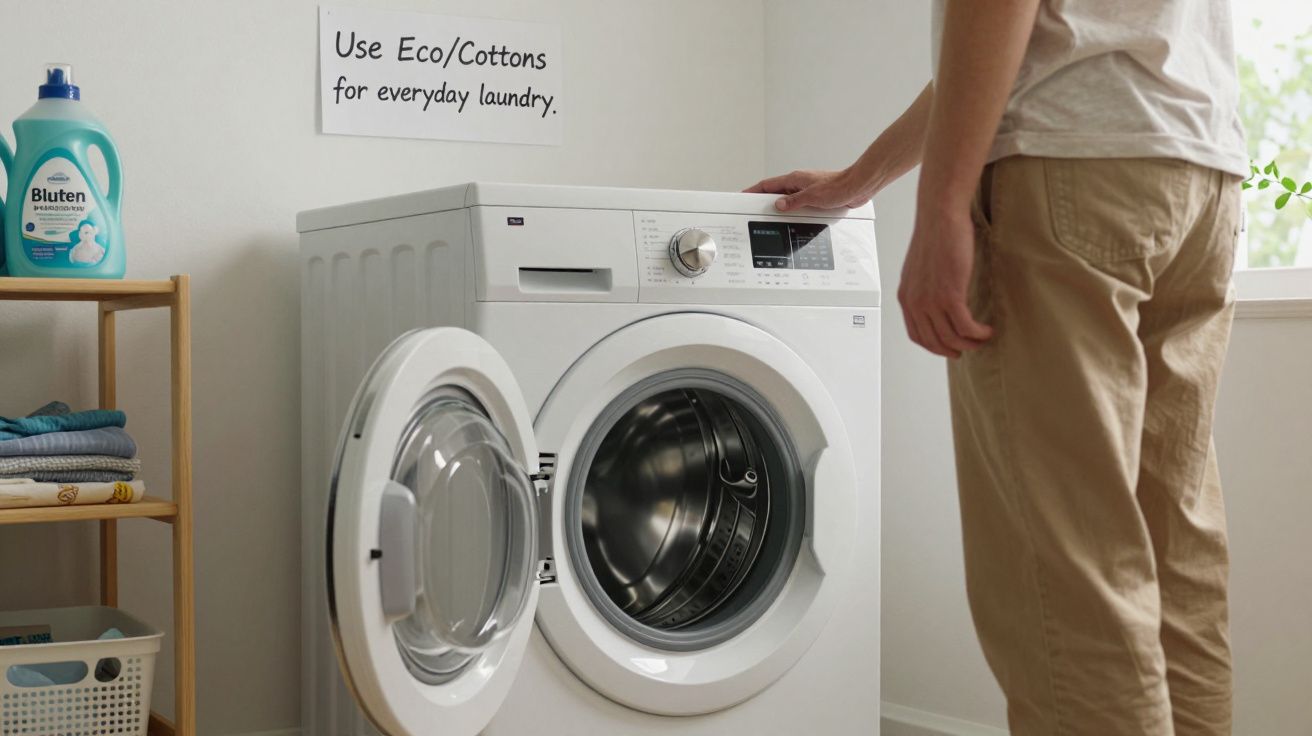
“Use the main cottons or eco 40–60 programme for most things, and be patient.”
It sounds perverse: pick the programme that shows two to three hours on the screen when you’re trying to save time and energy. But here’s the bit the display doesn’t explain:
- Eco or cotton cycles often use less electricity and water overall than a short, hot, high‑intensity wash.
- They are tested and optimised for cleaning performance and efficiency under European energy‑label rules.
- They give detergent and mechanics time to work at lower, cheaper temperatures.
A rough engineer‑approved rule of thumb:
Everyday clothes (mixed fabrics, light–normal soil)
Use: Cottons 40°C or Eco 40–60 with a full or ¾‑full drum.
Why: Strong mechanical action and long contact time at a modest temperature.Underwear, towels, bedding (especially if someone is ill or has allergies)
Use: Cottons 60°C (not the 60°C quick wash).
Why: Hotter water helps hygiene and shifts body oils in dense fabrics.Sportswear and synthetics
Use: Synthetics 30–40°C or a dedicated Sports cycle, lower spin if the label suggests.
Why: Protects elastic, avoids setting sweat odours with too much heat.
If your machine has a “Daily wash” or “Mixed load” cycle around 60–90 minutes, engineers tend to treat this as the acceptable compromise when you truly cannot face a two‑hour eco. It still runs a full wash sequence; it’s just tuned for typical everyday soil on modern detergents.
Quick comparison
| Cycle type | Best for | Why engineers like/dislike it |
|---|---|---|
| Eco 40–60 / Cottons | Most everyday laundry | Deep clean, energy‑efficient, kind to kit |
| Daily / Mixed | Regular clothes, light soil | Good balance of time and performance |
| 15‑min quick wash | Almost‑clean small loads | Fine for freshening, poor for real dirt |
When a 15‑minute quick wash is actually fine
Quick wash isn’t evil; it’s just specialised. Used for the right things, it’s genuinely handy. Keep it for:
- Very small loads – one outfit, a couple of T‑shirts, not half your wardrobe.
- Lightly worn items – something you’ve had on for a few hours, not gardening trousers.
- Freshening up clothes that smell a bit stale from the cupboard or suitcase.
- Non‑critical items – not baby clothes, not towels, not anything that sits close to broken skin.
And even then:
- dose detergent lightly (too much is pointless on a short cycle)
- avoid softener if you’re in a rush – it needs rinsing time to avoid build‑up
- shake items well before hanging so they dry quickly and don’t develop odour
Let’s be honest: nobody reads the entire manual for their washing machine. But this is the bit the small print is trying to tell you – quick wash is a top‑up, not the main event.
How to switch without wrecking your schedule
The biggest objection to ditching everyday quick washes is the clock on the display. Two hours plus feels unrealistic when you’re juggling work, kids, and a British forecast that can turn on you in ten minutes. So treat the machine like an extra pair of very slow, very reliable hands.
A few practical shifts:
Run long cycles when you don’t care about the time
Set a cottons or eco cycle:- first thing in the morning while you’re getting ready
- on a timer to finish as you get home
- overnight if your machine is quiet enough (and you’re not in a flat with thin walls)
Fill the drum properly
Aim for about ¾ full when dry – a hand’s width of space at the top. Under‑loading wastes water and energy; over‑loading stops clothes moving freely, which forces you back towards short cycles that can’t compensate.Drop the temperature, not the time
30–40°C on a full‑length eco is often cleaner and cheaper than 60°C blasted through in 30 minutes. Modern detergents are formulated for lower temps, given enough minutes.Match detergent to water hardness and soil
Read the tiny chart on the box once and adjust. Too little powder in hard water and low temps = dingy laundry. Too much on short cycles = residue and smells.Save tweaks for spin, not wash
If you’re in a hurry to dry, increase the spin speed on a long cycle rather than shortening the programme. Clothes come out drier but still properly washed.
One engineer put it bluntly: “Think in wash quality per week, not minutes per load. Two good long cycles beat five rushed ones.”
Everyday laundry without the quick‑wash crutch
Once you stop treating 15‑minute quick wash as the default, a calmer rhythm appears. Maybe you run a big eco 40–60 on Sunday, a cottons 60°C for towels mid‑week, and a synthetics cycle for sportswear as needed. Quick wash becomes what it was meant to be: the emergency button, not the main setting.
The payoff is slow but obvious: clothes keep their colour and shape longer, towels fluff back up, that odd sour smell disappears from the airing cupboard. Your machine stays cleaner inside, so breakdowns and black mould around the door are less likely.
You still press “start” – you just ask the machine to do the job it was actually built for.
FAQ:
- Does a longer cycle really use less energy than a quick wash?
Often, yes. Eco and cotton programmes wash at lower average temperatures and use clever drum rhythms to get the same or better cleaning with less electricity and water. Quick washes may heat water faster and rely on intense mechanical action, which can be surprisingly hungry for power.- Is 60°C always better for hygiene?
Not always, and it costs more. Reserve 60°C for towels, bedding, cloth nappies and underwear when you need that extra hygiene. For most everyday clothes, a good 40°C eco or cottons cycle with decent detergent is enough.- My machine has a 30‑minute ‘rapid’ cycle, not 15 minutes. Is that OK for everyday?
It’s slightly better, but the same principle applies: rapid programmes are designed for lightly soiled, small loads. For regular family laundry, engineers still recommend the main cottons or eco programmes.- What about hand‑wash and delicate cycles – are they better than quick wash?
They’re gentler on fabrics but not necessarily “cleaner”. Delicate cycles reduce drum movement to protect items like wool and silk. For robust everyday fabrics that actually get dirty, a full cottons or eco cycle is still the most effective choice.






Comments (0)
No comments yet. Be the first to comment!
Leave a Comment