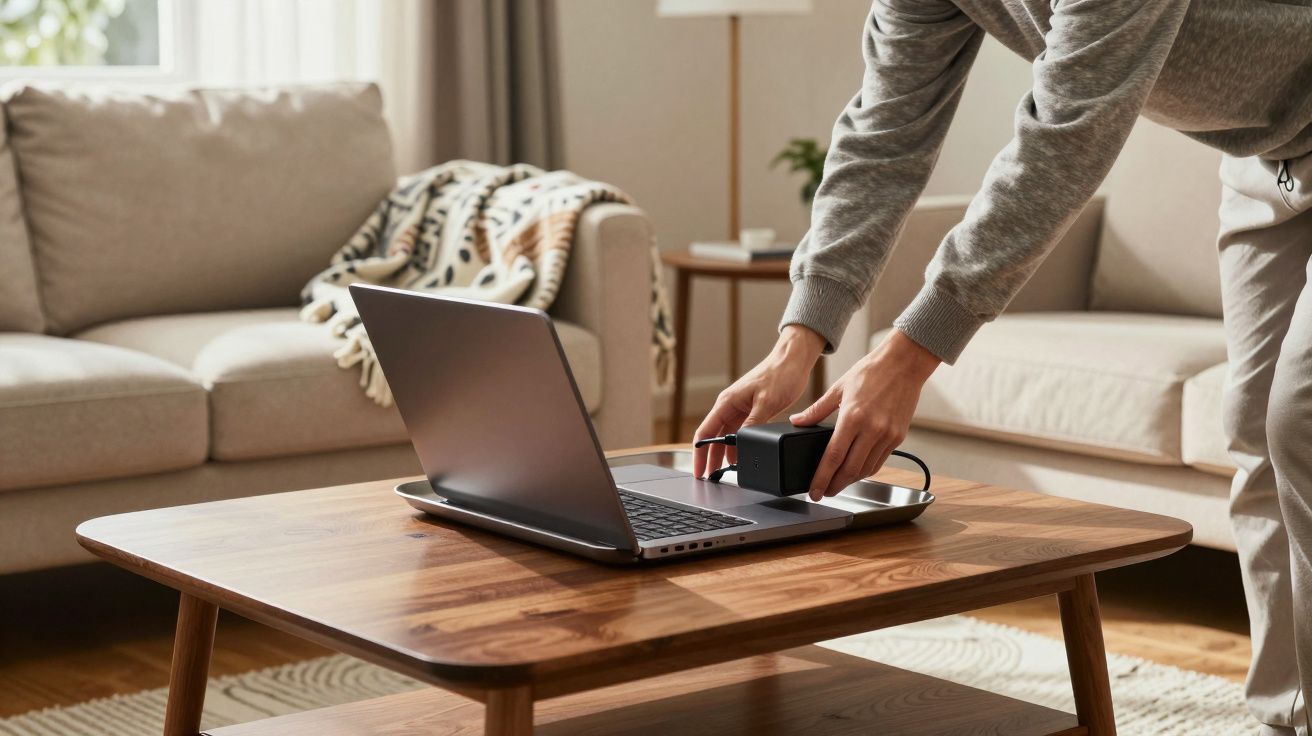
The laptop balanced on the arm of the sofa feels harmless. You plug it in “just for a bit”, tuck the cable out of the way and head to the kitchen. Ten minutes, an email, maybe a quick episode of something. The charger hums quietly into the cushions. The fabric warms. Nobody notices.
Firefighters do. They walk into living rooms where the only obvious clue is a blackened dip where the sofa used to be, windows cracked from the heat, walls slick with soot. The origin point is often small: a tablet left charging on a pile of washing, a laptop buried under a throw, a cable pinched under a chair leg. The pattern is now so familiar that crews have a simple, old-fashioned suggestion: if you need to charge in the lounge, do it on a tray.
This isn’t about paranoia or banning screens from the sitting room. It’s about understanding how modern batteries fail, why soft furnishings turn a tiny fault into a full-blown fire, and how a £5 metal tray or ceramic board can buy you precious minutes you will not get any other way.
What firefighters actually see after a “small” charging mishap
Ask crews what a sofa fire looks like and they rarely talk about towering flames first. They talk about smoke. Thick, dark, choking smoke that fills a room in under three minutes and stains everything it touches. They talk about the smell of burnt foam and plastic, and about people who thought they had more time than they did.
The ignition source is often modest:
- A laptop on fast charge resting directly on the sofa.
- A tablet wedged down the side of a cushion, still plugged in.
- A charger brick buried under a blanket where a child was watching films.
“By the time you see flames, the toxic smoke has already done its work,” one fire officer told a community meeting. “The soft furniture gives the fire a head start.”
Many of these fires start when people are in the house but not in the room. Someone pops upstairs, gets distracted, or falls asleep in front of the TV. The device overheats, foam catches, and by the time the alarm sounds, escape routes are already compromised.
Why sofas and beds turn minor faults into major fires
Laptops and tablets are designed to get warm. Batteries charge and discharge, processors work hard, chargers convert voltage. In the open air on a hard surface, that heat has somewhere to go. On a sofa, it doesn’t.
Three things make sofas and beds particularly dangerous:
- Insulation: Cushions, duvets and throws trap heat around the device and the charger. Components that are happy at 35–40 °C can quickly reach far higher temperatures when smothered.
- Fuel: Foam, synthetic covers, decorative cushions and soft toys all burn fiercely once they catch. They also drip and spread flaming material.
- Concealment: A tablet half-buried in a blanket or tucked behind a cushion lets a fire grow unnoticed in its first crucial minutes.
Common everyday habits quietly stack the odds:
- Leaving devices charging on the sofa or bed overnight.
- Covering a warm laptop with a blanket “to keep it safe”.
- Running cables under rugs or cushions where they can overheat or get damaged.
- Using cheap, unbranded chargers that don’t have proper safety cut-outs.
- Ignoring swollen batteries, hot smells, or chargers that buzz or crackle.
A table-top or hard floor will not magically make faulty equipment safe, but it removes the layers of foam and fabric that turn a fault into an inferno.
Typical charging spots, and how risky they are
| Charging spot | Risk level | Main issue |
|---|---|---|
| Sofa, armchair, bed, pile of clothes | High | Trapped heat + lots of fuel |
| Carpeted floor, on a rug | Medium | Some fuel, less ventilation |
| Hard table, worktop, ceramic tile | Lower | Better ventilation, fewer combustibles |
How lithium‑ion battery fires behave
Most modern laptops and tablets use lithium‑ion batteries. When they fail safely, they simply stop holding charge. When they fail unsafely - from damage, manufacturing faults or sustained overheating - they can go into what engineers call “thermal runaway”.
In plain terms, that means the battery starts to heat itself faster than it can cool down. Internal pressure builds, gas vents, and you may see or hear:
- Hissing, popping or bulging from the device.
- Thick white or grey vapour.
- A sudden jet of flame from the battery area.
The process can move very quickly. A device that looked fine on the coffee table ten minutes ago can be ejecting flames into a cushion now. Throw in synthetic fabric and you have an intense, fast-spreading fire that is hard to control without proper equipment.
You cannot “reason” with a battery in runaway. Your job is to get space and get out.
If a device starts smoking or hissing:
- Do not pick it up with bare hands.
- If it is safe, turn off the power at the wall; don’t lean over flames to do so.
- If you can safely move the device with a long object onto a hard, clear floor or out through a door, do it from a distance.
- Close the door to the room, get everyone out, and call 999. Do not re-enter to “have another look”.
The simple charging tray fix firefighters keep recommending
When crews talk about safer charging in living rooms, they are surprisingly low-tech. They are not asking you to install sprinklers over the sofa. They are asking for something your kitchen probably already has: a metal or ceramic tray.
The idea is straightforward:
- Put the tray on a hard, stable, non-flammable surface - a coffee table, tiled hearth, wooden sideboard, kitchen worktop.
- Charge your laptop, tablet or phone on the tray, not on soft fabric.
- Keep the tray clear around the edges so heat and smoke are visible if something starts to go wrong.
This acts like a small fire break. If a charger fails or a battery vents, flames are more likely to hit metal or ceramic first, not straight into foam or curtains. It also keeps cables from slumping into the sofa or under a cushion.
What makes a good charging tray
Firefighters typically suggest:
- Material: Metal baking tray, roasting tin, ceramic or stone chopping board, or a purpose-built fire‑resistant charging mat.
- Size: Big enough that the device and charger brick both sit fully on the tray with space around them.
- Edges: A small lip or raised edge helps contain sparks or molten plastic.
- Location: Away from curtains, paper piles and soft furnishings; ideally near a socket to avoid under‑rug cable runs.
Examples that work in most homes:
- A spare baking tray on a coffee table, with a rule that “if it’s plugged in, it lives on the tray”.
- A ceramic serving platter on a sideboard acting as a family charging station.
- A heat‑resistant board on a kitchen counter for laptops on fast charge.
A tray is not a licence to leave things on charge for days. It’s a margin of safety when real life is messy.
Practical rules for safer charging at home
You do not need to memorise fire‑engineering manuals. A small set of habits covers most of the risk.
- Keep charging off the sofa and bed. No exceptions for “just five minutes”. If you are tempted, move the device or move yourself.
- Use a hard, clear surface. Table, desk, worktop, charging tray, or bare floor with space around it.
- Avoid overnight charging on soft furnishings. If something must charge while you sleep, keep it on a tray or table, away from escape routes.
- Stick to proper chargers. Use original or reputable branded chargers with UK safety markings. Bin damaged or loose-fitting plugs.
- Check cables and batteries. Replace leads that are frayed, kinked or hot to the touch. Do not ignore swollen cases or screens lifting around the edges.
- Give devices room to breathe. Do not stack them while charging, and keep vents unblocked.
- Tidy, don’t hide, cables. Use clips or trunking rather than running leads under rugs or cushions.
- Teach the rule to children and teens. Many sofa fires start in kids’ rooms or gaming corners where habits are hardest to police politely.
If you live in a flat or small house, also keep escape routes clear. A burning laptop in a cluttered hallway is far more dangerous than the same fire on a bare, visible surface.
What to do if the worst happens
Even with good habits, things can still go wrong. The priorities are simple:
- Raise the alarm early. Smoke alarm sounds = stop what you’re doing and investigate carefully.
- Don’t take risks for objects. No laptop, tablet or phone is worth your lungs.
- Close doors behind you. A closed door slows the spread of smoke and fire.
- Get everyone out and stay out. Call 999 from outside or from a neighbour’s home.
- Tell firefighters what’s burning. If you know it started with a device or battery, say so when you call.
The quiet choices you make now - a tray on the table, a rule about no charging on the sofa - decide how much time you have if a fault appears. Time is the one thing you cannot buy when the room fills with smoke.
FAQ:
- Is it really that dangerous to charge a laptop on the sofa? Yes. Most of the time nothing happens, but when chargers or batteries fail, soft furnishings help the fire spread extremely quickly. Fire services across the UK have linked many serious fires to devices charging on sofas or beds.
- Do quality branded devices and chargers still pose a risk? They are generally safer, but no device is risk‑free. Damage, blocked vents, trapped heat or simple ageing can still cause failures, which is why the surface you charge on matters.
- Is a wooden table safe enough without a tray? A clear wooden table is far safer than a sofa or bed, especially if it’s not piled with papers or cloth. A metal or ceramic tray adds another layer of protection but is not essential if you already have good clearance.
- Can I use a silicone mat instead of a metal tray? A thick, heat‑resistant silicone mat is better than bare fabric, but non‑combustible materials like metal, ceramic or stone are preferable because they won’t burn at all.
- Should I unplug devices once they’re fully charged? Yes. Unplugging reduces wear on batteries and chargers and cuts the time something is energised, which lowers the overall risk of a fault turning into a fire.




Comments (0)
No comments yet. Be the first to comment!
Leave a Comment