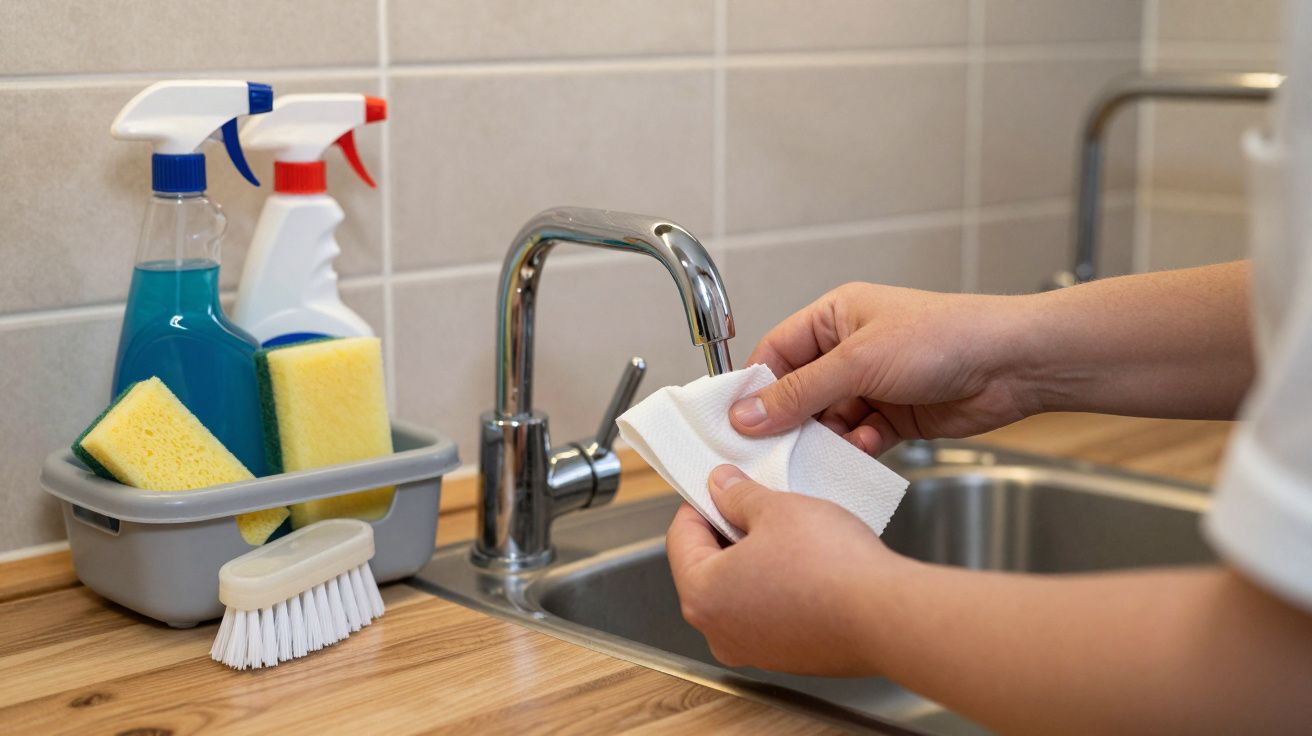
Every evening the chrome catches the light and you notice it again: that chalky ring around the base of the tap, the crust on the spout, the dull halo where water dries. You wipe, you buff, it looks better wet – and then the white comes back. Vinegar makes the kitchen smell like a chip shop, bleach feels too harsh around little hands, and the fancy limescale gel you bought is still half full under the sink.
One day you watch a professional cleaner fly round a bathroom you’ve been wrestling with for months. No nose‑stinging fumes, no heavy scrubbing, and yet the tap comes up like a showroom display. You expect a specialist acid. She reaches into her caddy… and pulls out a warm bottle of cheap cola.
You laugh, she shrugs, and ten minutes later the crust has melted. It’s not magic. It’s chemistry in a can.
Why limescale clings so stubbornly
Limescale isn’t grime you can just “wipe off”. It’s mineral build‑up – mainly calcium carbonate – left behind every time hard water dries on metal. Each splash adds a whisper‑thin layer. Weeks turn to months, and suddenly your shiny tap has a stony collar.
Cream cleansers and all‑purpose sprays do a decent job on soap scum and fingerprints, but they barely touch hardened scale. You scrub harder, which risks scratching the chrome. You reach for bleach, which makes things look whiter, but doesn’t actually dissolve the mineral. Fresh water hits the same spots and the cycle continues.
The trick is to stop scrubbing and start dissolving. That means a mild acid, held against the limescale long enough for it to do the work for you.
The cheap fizzy drink cleaners actually use
Ask a few housekeepers and facilities teams off the record and you’ll hear the same confession: when they’re stuck with a scaled tap and no specialist descaler to hand, they’ll quietly grab cola.
Not the fancy craft stuff, not sugar‑free tonic – just the brown, budget cola you’d happily buy for a picnic. The brand doesn’t matter much. What matters are the acids in the drink.
Cola usually contains:
- Phosphoric acid – very effective at breaking down calcium deposits.
- Carbonic acid (from the fizz) – weak, but helps the process along.
- A slightly low pH, often around 2.5.
Hold that against limescale and it starts to nibble away at the deposit. You’re using the same basic principle as a commercial descaler, just in a gentler, off‑the‑shelf form that happens to cost under a pound a bottle.
“It’s not our only method, but if a client’s out of product and the tap’s a state, cola will absolutely save the day,” says Nina, a contract cleaner in Birmingham. “Five minutes soaking does more than twenty minutes of furious scrubbing.”
Vinegar can do a similar job, but the sharp smell hangs in the room. Bleach will not remove limescale at all – it just disinfects and can dull some finishes. Cola sits in a sweet spot: cheap, available, and surprisingly effective in short bursts.
How to lift limescale with cola in under 10 minutes
You don’t need to drown the sink. You just need to keep the cola in contact with the scale.
Pick your cola wisely
Use the cheapest supermarket cola you can find. Full‑sugar tends to work slightly faster, but diet versions still have the right acids. Avoid coloured “energy drinks” with sticky additives.Protect the area
Lay an old cloth or bit of kitchen roll around the base of the tap to catch drips. If you’re near natural stone (marble, limestone), keep the cola strictly on the metal – those surfaces hate acid.Soak some paper or cotton pads
- Tear a few strips of kitchen roll or grab some cotton wool pads.
- Soak them in cola until saturated but not pouring.
- Tear a few strips of kitchen roll or grab some cotton wool pads.
Wrap the limescaled areas
- Press the soaked paper firmly around the base of the tap and any crusty rings.
- For the spout, you can:
- Fill a small food bag or latex glove with cola, then
- Slip it over the end of the tap and secure with an elastic band so the spout sits in the liquid.
- Fill a small food bag or latex glove with cola, then
- Press the soaked paper firmly around the base of the tap and any crusty rings.
Wait 5–10 minutes
This is where the work happens. No scrubbing yet. On light build‑up, five minutes is often enough. On heavier rings, edge towards ten, checking every few minutes.Loosen and wipe
- Remove the paper/bag.
- Use a soft cloth or non‑scratch sponge to wipe the softened limescale away.
- Stubborn spots? Gently go over them with an old toothbrush; the deposit should flake without much effort.
- Remove the paper/bag.
Rinse thoroughly
Rinse the tap with clean water and wipe dry to remove any sticky residue. This step matters – cola left to dry can attract dust and look dull.Polish and inspect
Buff with a microfibre cloth. If you still see dull patches of scale, repeat the wrap once more. Two short soaks beat one long, risky one.
Common mistakes that ruin the trick
Most failures aren’t about the cola; they’re about how it’s used.
Dunking, not holding
Pouring cola over the tap and hoping for the best mostly wastes the drink. The acid needs time in contact with the scale, which is why wraps and bags work so well.Leaving it for ages
Let’s be honest: nobody sets a timer every single time. But don’t wander off for an hour. Long soaks can dull cheaper chrome or mark nearby grout. Stick to 5–10 minutes, especially the first time on a new fitting.Scrubbing with the wrong tool
Scourers, steel wool and sharp scrapers can scratch finishes beyond rescue. If the limescale doesn’t wipe away easily after soaking, repeat the soak; don’t escalate your abrasives.Skipping the rinse
Cola is sticky. If you don’t rinse and dry, you’ll trade limescale for a slightly tacky tap that grabs dust and fingerprints.
“The cola is your softener, not your cleaner,” says Nina. “Rinse and a proper bathroom spray afterwards leaves things sparkling and sanitised.”
When cola isn’t the right answer
Cola is a handy hack, not a universal solution. Sometimes you should reach for something else.
Natural stone around the tap
Marble, travertine and limestone don’t play nicely with acids, even weak ones. If the base of your tap sits on stone, keep the cola above the surface and use a purpose‑made stone‑safe limescale remover instead.Very heavy or years‑old deposits
If the tap aerator is a solid white lump or water is spraying sideways, you may need to unscrew the end of the tap, soak just that part in a stronger descaler, or replace it entirely. Cola is great as a first pass, less so for extreme cases.Discoloured or pitted chrome
Where the finish is already damaged, any acid – even mild – can make the flaws more obvious. Test on a tiny area at the back first, or stick to neutral cleaners and gentle mechanical cleaning.Food preparation areas
Around kitchen sinks, always follow up with a food‑safe cleaner after the cola treatment, to make sure everything is properly rinsed and disinfected.
Quick comparison: cola vs vinegar vs bleach
| Method | Best for | Watch out for |
|---|---|---|
| Cola | Light–moderate limescale on taps | Sticky if not rinsed; avoid stone |
| Vinegar | Limescale on removable parts | Strong smell; dilute on delicate areas |
| Bleach | Whitening grout, disinfecting | Does not remove limescale; corrosive to some metals |
Use cola as your fast, friendly fix; keep vinegar for deeper soaks in a bowl; reserve bleach for jobs where you genuinely need disinfection and whitening, not descaling.
A tiny habit that keeps taps clear
Once you’ve seen how quickly the crust lifts, it’s tempting to treat cola like a miracle tool. It isn’t; it’s just an easy way to catch limescale before it wins.
Make it a small habit instead of a rescue mission. Every few weeks, when you notice the first pale ring rather than a thick ridge, give the tap a five‑minute cola wrap before you clean the rest of the bathroom. Wipe, rinse, dry. That’s it.
You’re not turning your sink into a drinks advert. You’re using a cheap, familiar liquid in a smarter way. Tell the friend who’s tried every spray going. Show the relative who thinks only harsh chemicals work. Try it on the tap you secretly avoid looking at, and see how different it feels to have the metal shine again.
You don’t need bleach burns or vinegar clouds to beat limescale – just a bit of fizz, used on purpose.
FAQ:
- Will diet cola work, or does it have to be full‑sugar? Both can work, because it’s the acids that matter, not the sugar. Full‑sugar cola sometimes feels a touch faster, but diet cola still contains phosphoric and carbonic acids and will dissolve limescale if you give it time.
- Is this safe for brushed nickel, brass or black taps? Always patch‑test on the back first. Many modern finishes are fairly robust, but some speciality coatings are more sensitive to acids. Keep contact time short initially and stop if you notice any dulling.
- Can I pour cola straight down the loo for limescale in the bowl? You can, and it will soften light scale if you leave it to sit, but you’ll need a fair amount of liquid. For thick toilet limescale, a dedicated descaler is usually more economical and effective.
- How often can I use cola on the same tap? Used sensibly – short contact times, thorough rinsing – a cola soak every few weeks is unlikely to harm standard chrome. If you find you need it more often, consider tackling the cause with a tap aerator clean or a small water‑softening solution.
- Do I still need a proper bathroom cleaner? Yes. Cola helps break down limescale, but it doesn’t properly disinfect or deal with all types of grime. Use it as a pre‑treatment, then clean as normal with a suitable bathroom spray or cream cleanser.

Comments (0)
No comments yet. Be the first to comment!
Leave a Comment