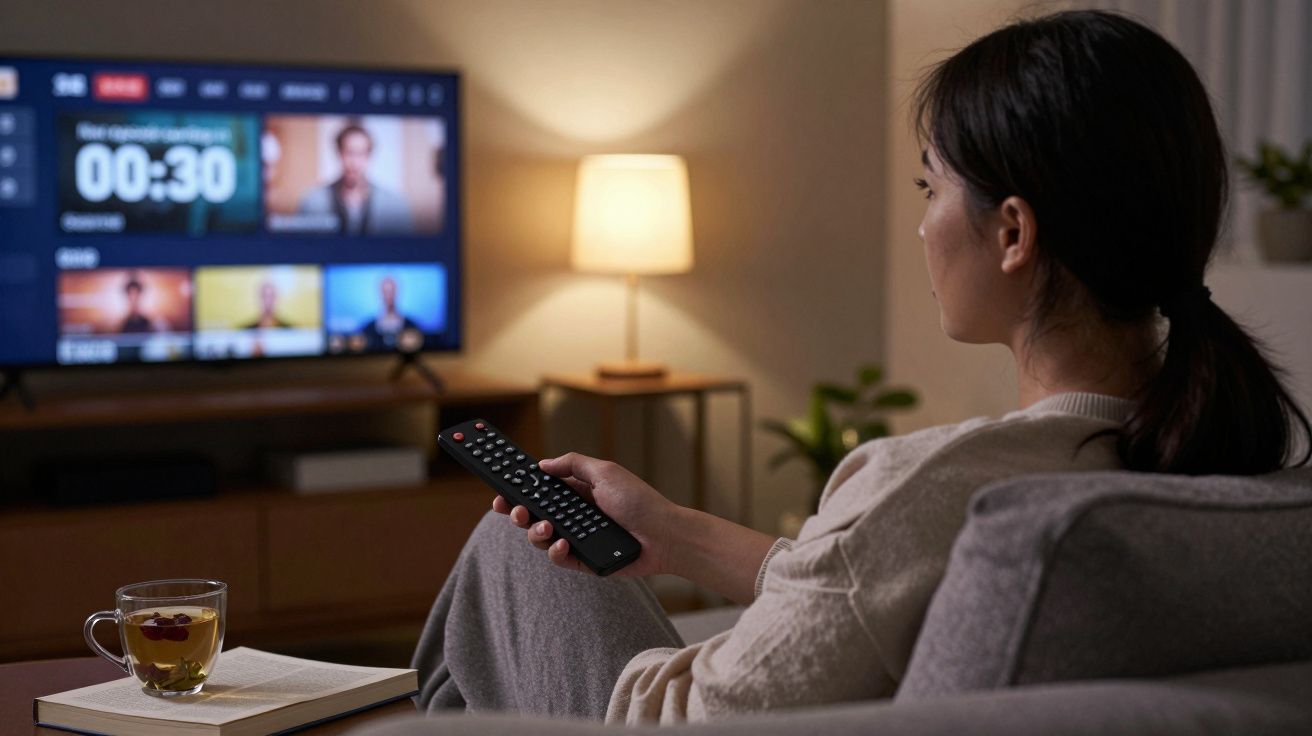
The countdown pops up in the corner of the screen: “Next episode in 5… 4… 3…”.
You tell yourself you’ll just watch until the next cliffhanger is resolved, then you’ll sleep.
Twenty minutes later you’re deep into another plot line, the room is darker, your shoulders are hunched, and tomorrow’s alarm feels like a problem for Future You.
We’ve all done the mental gymnastics. You add up how late you can push bedtime, how many minutes you can shave off your morning routine, whether that 9am meeting really needs you fully awake. The numbers almost never work, but the episode wins anyway. Your body is ready to slow down; the platform is designed to keep you up.
The next day you don’t just feel tired. You feel oddly wired and flat at the same time, as if your brain has jet lag without the holiday. You scroll through the morning on autopilot, promise yourself you’ll be sensible tonight, then sit down on the sofa and feel your resolve dissolve with the opening credits.
Psychologists who work on sleep problems see this over and over. The issue is not a lack of willpower; it’s that late‑night streaming is tugging on the same systems that regulate your body clock.
The good news is that the fix they recommend is much smaller than “never binge again”.
It’s a 20‑minute window. And it starts before you think you’re tired.
Why “just one more episode” is harder to resist at night
Streaming platforms are built around frictionless continuation. Autoplay, cliffhangers, “because you watched”, the way credits shrink into a corner so the next story starts before you can reach the remote. During the day, you can shrug and turn it off; at midnight, those same nudges land differently.
By late evening, your self‑control is running on fumes. Your prefrontal cortex – the bit that makes long‑term decisions – is tired. The reward system that lights up when something is funny, shocking or emotionally intense? That’s still very much awake. The later it gets, the more your brain discounts tomorrow morning.
On top of that, stories are engineered to pull you into a “flow” state. You lose track of time; your sense of sleepiness gets masked by stimulation. You may notice your eyes feel dry, but the emotional cliff takes priority. Your brain is processing fictional threats and dramas instead of listening to your body’s quieter signals.
There’s also the small matter of social timing. If everyone is talking about the finale, it feels like you’re “behind” if you switch off. That subtle pressure can make an 11pm double‑episode feel strangely reasonable on a Tuesday.
How late‑night streaming hijacks your body clock
Your body runs on a roughly 24‑hour rhythm, anchored by light and regular routine. In the evening, melatonin starts to rise, your core temperature drops slightly, your digestive system slows. All of that is your biology saying: we’re heading towards sleep.
A bright screen in a dark room sends a very different message. The blue‑heavy light from phones, tablets and TVs tells your brain it’s still daytime, especially when it’s close to your eyes. Melatonin release is delayed; your internal clock is nudged later. You feel tired, but your hormones are saying “stay up a bit more”.
The content itself matters too. Fast cuts, emotional twists, jump scares or intense drama keep your nervous system on a low simmer. Heart rate and stress hormones don’t immediately drop the moment you hit pause. It’s like slamming the brakes while the engine’s still revving.
Over time, that pattern adds up:
- You fall asleep later than your natural window.
- You still wake at the same weekday time.
- You build up a quiet sleep debt across the week.
- Your body clock drifts towards “night owl”, even if your life is not.
Researchers sometimes call the result “social jet lag”: your internal time and your external timetable stop matching. You feel hungover on sleep loss alone.
The 20‑minute wind‑down trick psychologists recommend
Therapists who specialise in insomnia use something deceptively simple: a protected wind‑down period that starts before bed, not at the moment you finally turn the TV off. Think of it as a buffer between “story world” and “sleep world”.
The version many psychologists suggest for late‑night streamers is a 20‑minute screen‑free slot right before your intended lights‑out time. Not an hour, not a perfect evening routine. Just 20 minutes you actively reserve from the algorithm.
It works best if you set it up in four moves:
Pick a real bedtime – and work backwards
Decide what time you actually need to be asleep to function tomorrow. Subtract 20 minutes: that’s when streaming must stop, not when you start thinking about stopping. Say it out loud or write it down: “I turn the TV off at 22:40.”Decide your episode limit in advance
Before you hit play, choose how many episodes fit that stop time. Two 45‑minute episodes? Fine – as long as you start early enough. When you know there is no “sneaky extra”, each episode becomes part of a plan, not a negotiation.Fill the 20 minutes with wind‑down, not willpower
Staring at a blank wall for 20 minutes makes you think about the show you’re missing. Instead, line up low‑key, offline tasks that gently tell your body it’s safe to switch off:- Dim the lights and tidy a small area you can finish (coffee table, bedside).
- Do a short stretch routine or a few slow yoga poses.
- Read 6–8 pages of something genuinely calm, not a thriller.
- Take a warm shower, then get into sleep clothes.
- Practise a simple breathing pattern (inhale for 4, exhale for 6).
The content here is boring on purpose. You’re teaching your nervous system that this sequence equals “we’re done for today”.
- Use an “if‑then” rule for the cliffhanger moment
Psychologists call these implementation intentions. For example:
“If the next‑episode countdown appears after my cut‑off time, then I press back and put the remote on the shelf.”
You decide the action in advance, so 1am‑you doesn’t have to invent a boundary on the spot.
The first few nights may feel strangely empty. Your brain is used to constant input right up until sleep.
Give it a week. You’ll start to notice that 20 minutes go by very fast once they have a structure.
“Think of the 20‑minute buffer as a little jet bridge between the noisy terminal of your day and the quiet cabin of your night.”
- Set the stop time, not just the bedtime.
- Put your phone on charge in another room before you start wind‑down.
- Use lamps or warm‑tone bulbs; avoid switching on overhead white light.
- Keep the same routine on weeknights; let weekends flex a little, not a lot.
- Treat slip‑ups as data, not failure. Adjust and try again the next evening.
What this changes for your evenings (and your mornings)
At first glance, 20 minutes looks trivial. It’s half an episode, two scrolls of a social feed, one distracted teeth‑brushing. In practice, it reshapes the whole edge of your night. You stop falling asleep by accident and start doing it on purpose.
People who try this consistently for a fortnight often report the same quiet shifts:
- They fall asleep faster once they’re in bed.
- Morning grogginess shortens; the “fog” lifts earlier.
- Binge sessions move earlier in the evening or onto weekends.
- The need for a second coffee just to feel baseline drops.
You also start to renegotiate your relationship with “just one more”. When you know there is a non‑negotiable buffer before sleep, that extra episode now has a visible cost: it eats into your wind‑down, not some abstract “rest time” you never really see.
Here’s how the trade‑off looks in simple terms:
| Key move | What you actually do | Why it helps |
|---|---|---|
| Set a hard stop time | Turn off streaming 20 minutes before sleep | Protects your body clock from drifting later |
| Do a screen‑free ritual | Repeat the same calm tasks nightly | Trains your brain to associate them with sleep |
| Plan episodes, don’t improvise | Decide the number before you start | Reduces late‑night bargaining with yourself |
None of this means you can’t ever stay up for a finale or a live match. It means that, by default, your evenings are built around your biology, not the autoplay countdown.
Once you’ve felt what a properly rested morning actually feels like, it becomes harder to trade it away for an episode you’ll barely remember in three weeks’ time.
FAQ:
- Do I really have to give up screens completely before bed? No, but moving the most stimulating screens (TV, phone, tablet) at least 20 minutes away from lights‑out makes a real difference. If you do look at a screen in that window, keep brightness low and content gentle.
- Is blue‑light blocking enough on its own? Blue‑light filters and glasses can help a bit, but they don’t touch the problem of mental stimulation. The plot, pace and emotions keep your brain alert even if the light is warmer.
- What if my only free time is late at night? Then the 20‑minute wind‑down becomes more important, not less. You may not be able to go to bed early, but you can still give your body a clear “now we stop” signal so the sleep you do get is deeper.
- Can I use the 20 minutes to scroll on my phone instead? That defeats the purpose. The idea is to step away from interactive, bright, fast‑changing content. Think analogue: paper book, pen and notebook, stretching, tidying, skincare.
- How long until I notice a change in my sleep? Many people feel a difference within three to five nights, especially in how long it takes to drop off. For more entrenched sleep problems, keeping the routine going for 2–3 weeks gives your body clock time to reset.



Comments (0)
No comments yet. Be the first to comment!
Leave a Comment