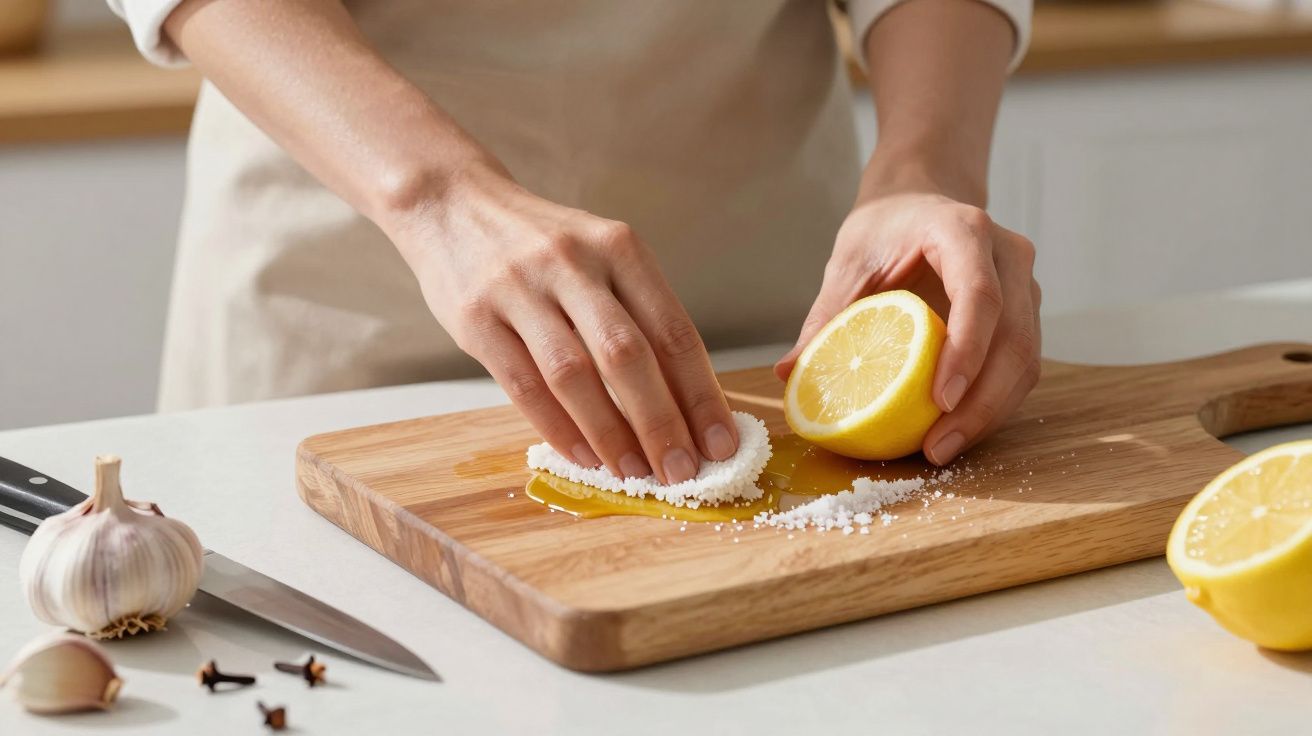
The garlic went in last, as it usually does. Two cloves, smashed with the side of the knife, chopped into a lazy pile on the same wooden board you use for everything. Dinner was good, plates cleared, kitchen wiped down. You rinsed the board, gave it a quick sudsy scrub, propped it by the sink and thought no more of it.
The next morning you sliced an apple on that board and paused halfway through the first bite. Not just apple. Garlic‑apple. You rinsed the knife again as if that would change anything. By lunchtime, the faint whiff had climbed into the chopping surface itself. You told yourself it was “just a smell”, but a small, sensible part of your brain wondered what else might be lingering there that you couldn’t detect as easily.
Food safety scientists have been wondering the same thing-only with petri dishes instead of packed lunches. Their answer is surprisingly low‑tech: a teaspoon of oil, a handful of salt, and a 60‑second scrub that lifts both the smell and a good chunk of the hidden germs. The trick is understanding what, exactly, you’re trying to shift.
What’s really soaking into your wooden board
To the eye, a wooden chopping board looks solid. Under a microscope, it’s more like a landscape: tiny pores, knife grooves, grain lines where liquids can sneak in. That’s part of wood’s charm-it’s gentle on knives and can even trap and slowly kill some bacteria-but it also means juices can settle deeper than a quick rinse can reach.
Garlic brings its own complications. When you chop it, you release sulphur compounds and oils that carry that unmistakable smell. They’re fat‑loving, not water‑loving, which is why they cling so stubbornly to anything even slightly porous. Add in a little moisture and food residue, and you have a perfect micro‑habitat in those knife scars.
On its own, a garlicky board is more annoying than dangerous. The concern begins when boards are used for a bit of everything-raw chicken one day, salad veg the next-without a cleaning method that really clears the grooves. In lab tests, boards with visible scoring can harbour bacteria long after they look dry and clean to the naked eye.
“People trust smell as a safety signal,” says one food microbiologist I spoke to. “If they can’t smell anything bad, they assume the board is fine. But odour fades long before bacteria stop being a problem.”
Why hot water and washing‑up liquid don’t always crack it
You’re not wrong to reach for hot soapy water. Detergent and heat are the backbone of good kitchen hygiene, and they do remove a lot of surface contamination. The trouble is that some of the smelliest compounds in garlic and onion simply aren’t very interested in water at all.
Those sulphur compounds bind to fats and nestle into the oily film left behind by whatever else you’ve chopped. If your wash is rushed, lukewarm, or the sponge is already tired, the film survives the rinse. The smell is your clue-but even if you can’t detect it, the chemistry is the same.
There’s the bacterial side, too. Over time, microbes can form thin, slimy coatings known as biofilms in the fine cuts of the board. Biofilms are tougher to dislodge than free‑floating bacteria; they need mechanical action-a proper scrub-as much as they need soap. That’s where the oil‑and‑salt method quietly changes the game.
Think of your usual wash as wiping a surface. The scrub you’re about to learn behaves more like a deep clean of the top layer of the wood itself.
The oil and salt scrub: how it works (and how to do it)
Food safety researchers have been testing simple household ways to knock down both smells and microbial counts on boards. The combination they keep coming back to is wonderfully unglamorous: a little cooking oil, coarse salt, and a bit of elbow grease.
Here’s the sequence they recommend after chopping strong‑smelling foods like garlic, onion or raw meat:
Start with a scrape. Use a bench scraper or the flat of a knife to remove any stuck‑on bits. Rinse quickly under warm water.
Add the oil. Drizzle about a teaspoon of neutral oil (sunflower, rapeseed, groundnut) over the area you’ve used. You’re not marinating it-just enough to create a thin sheen.
Massage it in. With clean fingers or a bit of kitchen roll, rub the oil over the surface, following the grain. This lifts fat‑soluble garlic compounds and loosens residue in the shallow grooves.
Bring in the salt. Sprinkle a tablespoon or so of coarse salt (sea salt, kosher salt, cheap rock salt) over the oily patch. Avoid fine table salt; you want visible grit.
Scrub properly. Using a clean cloth, a dedicated board brush, or even half a lemon held cut‑side down, scrub the board in small circles, then along the grain. Press enough to feel the abrasion, especially where your knife normally lands.
Let it sit briefly. Give the salty paste a minute or two to draw out moisture and odours. No need for a long soak.
Rinse and soap. Scrape the slurry into the bin, then wash the board in very hot water with washing‑up liquid as you normally would. Rinse well.
Dry upright. Stand the board on its edge so air circulates on both faces. A damp, flat‑lying board is a friend to bacteria and warping alike.
The science is quietly neat. The oil dissolves the stubborn, fat‑soluble garlic compounds; the salt offers micro‑abrasion to scrub out the top layer of wood fibres and disrupt any developing biofilm. In lab settings, similar oil‑and‑salt scrubs have knocked back odour while significantly cutting bacterial counts on used boards.
Done regularly, it also leaves your board feeling smoother and less “fuzzy”, which makes it easier to clean next time.
When wood is wise-and when to reach for plastic instead
Wooden boards have a loyal fanbase, and not just because they look good in photographs. Multiple studies have found that some hardwoods can trap and gradually inactivate bacteria drawn into their pores, provided the surface is allowed to dry fully between uses. They’re kinder to knives, too.
That doesn’t mean one wooden board is enough for everything.
For raw meat, poultry and fish, food safety bodies still steer home cooks towards separate, easily disinfected boards-often plastic-especially if you’re not fastidious about cleaning. Plastic doesn’t absorb liquids in the same way, so a bleach‑safe, dishwasher‑safe board is practical here. For bread, fruit, veg, nuts, cheese and garlic, a well‑maintained wooden board is not only fine; it’s a pleasure.
There are, however, moments when a wooden board has done its time:
- Deep cracks or raised splinters you can’t sand smooth
- Blackened or dark stains that return even after scrubbing
- A persistent sour or “old meat” smell that outlasts the oil‑and‑salt treatment
If you wouldn’t happily eat something that had rolled across that surface, it’s a sign. Retire it to DIY duty, or let it go. A new board is cheaper than a bout of food poisoning.
A tiny kit for clean, neutral‑smelling boards
You don’t need a cupboard full of specialist cleaners. A small, deliberate set‑up does the job.
- Neutral cooking oil (keep a cheap bottle just for cleaning)
- Coarse salt in a jar or ramekin by the hob
- A stiff, dedicated board brush or old (clean) washing‑up brush
- A bench scraper or dough scraper
- A drying rack or a clear space to stand boards upright
As one environmental health officer put it to me, “The best cleaning method is the one you’ll actually use on a Tuesday night.” Keeping the tools within reach makes it far more likely you’ll give the board a quick scrub while the pasta water boils.
Simple habits that keep smells and germs in check
Board care doesn’t have to turn into a new hobby. A few small, mostly invisible rituals make the biggest difference.
- Rinse straight after use. Don’t let chopped garlic or meat juices dry into the grain. A fast, hot rinse buys you time.
- Scrub, then soak (briefly), not the other way round. Long soaks can swell and crack wood; instead, scrub with oil and salt, then a quick hot wash.
- Rotate your sides. Alternate which face of the board you use so both surfaces get to dry out thoroughly.
- Deep clean weekly. If you use your board daily, a weekly oil‑and‑salt scrub is a sensible baseline; more often if you’re on a garlic binge.
- Label or colour‑code. Dedicate one board to raw animal products, another to ready‑to‑eat foods. A small pencil mark on the edge is enough if colour‑coding feels excessive.
Here’s a quick way to match problems with fixes:
| Issue on the board | What you notice | What to do |
|---|---|---|
| Lingering garlic smell | Clean but still aromatic | Oil‑and‑salt scrub + hot wash |
| Greasy, dull patches | Feels slick even when “dry” | Extra‑long scrub, then mild wash |
| Grey/black scoring | Dark knife lines, rough to touch | Sand lightly or replace if very deep |
The goal isn’t sterile perfection; it’s a board that doesn’t quietly share last night’s dinner with today’s lunch.
FAQ:
- Is a garlicky smell on my board actually unsafe? On its own, no. The smell is mostly a nuisance. The risk comes when the same board also carries raw meat residues and isn’t properly scrubbed, giving bacteria a place to hide.
- Can I just use bleach on a wooden board? Household bleach solutions are best reserved for plastic boards. On wood they can raise the grain, lighten patches and leave an unhelpful chemical taint. Mechanical scrubbing with oil, salt and hot soapy water is kinder and effective.
- Does this method replace washing‑up liquid? No. The oil‑and‑salt scrub is a pre‑clean to lift fats and odours. You still need a proper hot wash with washing‑up liquid afterwards, followed by thorough drying.
- Will the oil make my board turn rancid? Not if you use a small amount and always wash with hot, soapy water afterwards. Any residual trace behaves more like a light conditioning treatment than a coating of old fat.
- How often should I do the full scrub? After particularly pungent jobs-garlic, onion, strong cheese, raw meat juices-and at least once a week if you use the board daily. Quick rinses can fill the gaps, but the regular scrub is what keeps smells and hidden germs in check.






Comments (0)
No comments yet. Be the first to comment!
Leave a Comment